India's Economy Outpaces Forecasts With 7.8% Growth in Final Quarter
Staff Writer: Zoya Ahmed
Published on: June 5, 2026, 7:30 p.m.
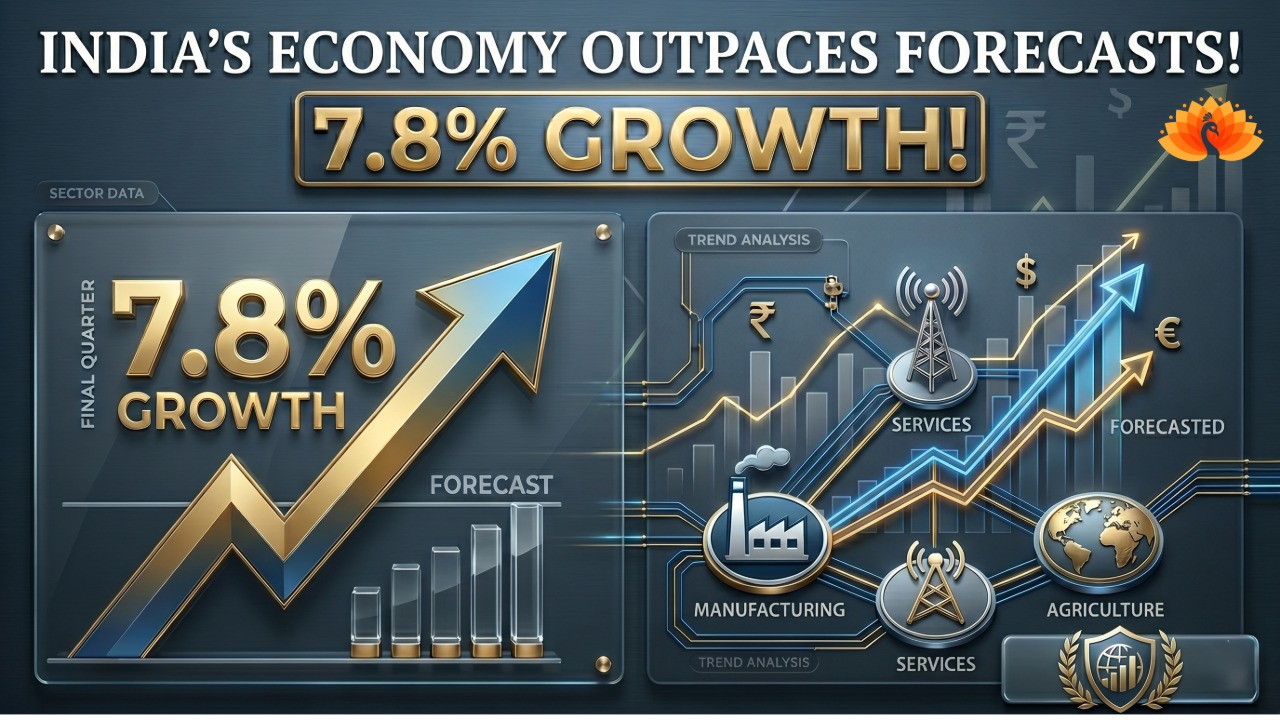
India’s economy expanded by 7.8 per cent in the January-March quarter of FY2025-26, surpassing market expectations and reinforcing the country’s position among the world’s fastest-growing major economies. The data was released on June 5 by the National Statistics Office (NSO), the government agency responsible for compiling India’s official economic statistics. Analysts polled by Reuters had forecast growth of 7.2 per cent for the quarter. For the full financial year 2025-26, India’s Gross Domestic Product (GDP) grew 7.7 per cent. GDP measures the total value of goods and services produced within a country over a specific period and is widely used to assess economic performance. Growth during the quarter was supported by strong investment activity and expansion across key sectors of the economy. Private investment, which refers to spending by businesses on assets such as machinery, infrastructure, and expansion projects, grew 10.8 per cent, its fastest pace in three years. Manufacturing output increased 7.3 per cent, while agricultural production expanded 3.6 per cent. Construction remained one of the stronger-performing sectors during the quarter, according to official data. Private consumption, or household spending on goods and services, grew 7.1 per cent, indicating continued domestic demand. Gross Value Added (GVA), a measure of economic output that excludes the effect of taxes and subsidies, grew 7.9 per cent during the quarter. Commenting on the data, Alexandra Hermann Prasad of Oxford Economics said a “notable deterioration in private consumption was offset by stronger investment.” Despite the stronger-than-expected performance, economists have cautioned that growth may moderate in FY2026-27 amid rising crude oil prices, geopolitical tensions in West Asia, and weather-related risks linked to a possible El Niño event. Earlier on Friday, the Reserve Bank of India lowered its GDP growth forecast for FY2026-27 to 6.6 per cent from 6.9 per cent. Economists will be closely watching the impact of global economic conditions, energy prices, and monsoon developments on growth in the year ahead.