Investigative Reporting on Rape Case in India
Staff Writer: Susmita Ghosh
Published on: March 5, 2026, 5:13 p.m.
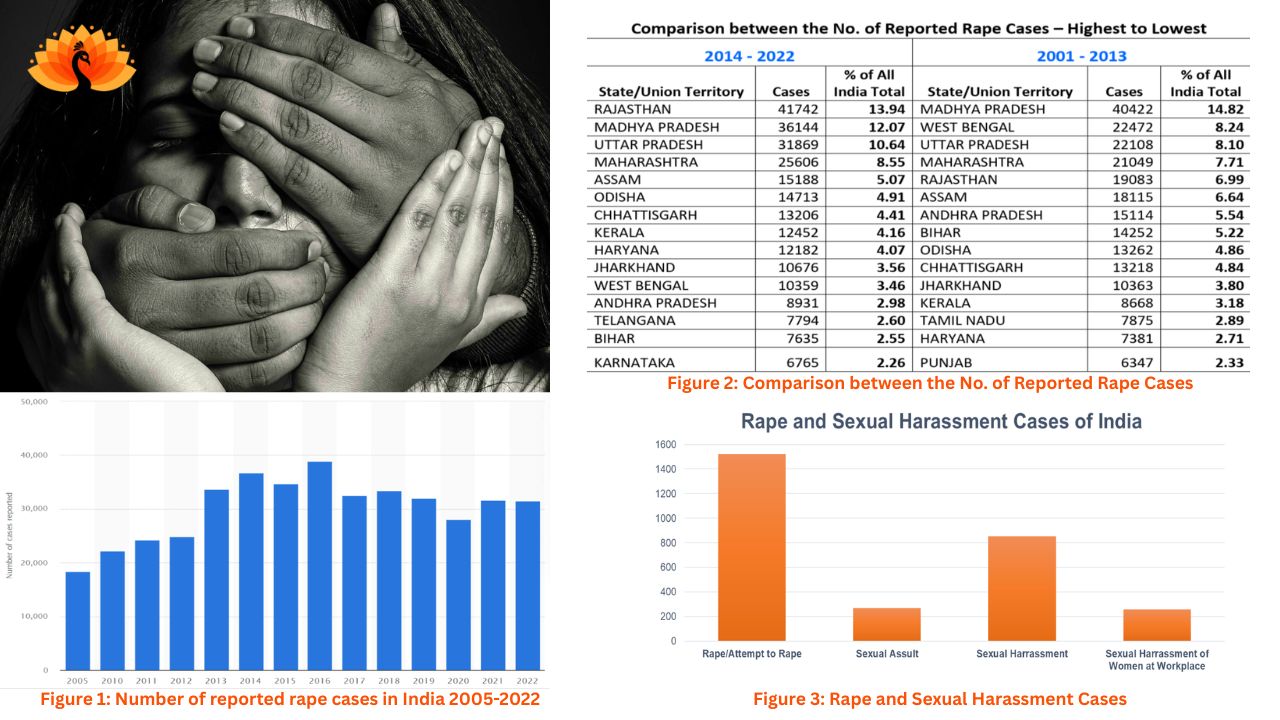
Rape cases are explained by Bharatiya Nyaya Sanhita, 2023 (BNS) in India. Section 63 of the BNS, states that any kind of sexual act that has been performed without consent of any women against her will, or by coercion are known as rape. The rape cases are observed as gender-based violence and expose flaws in legal, social and institutional purpose. Rapes are classified into various types such as: Standard Rape (Section 64(1)), Gang Rape (Section 70), Rape of a Minor (Section 64(2) and Custodial Rape (Section 64(2)). Rape cases are increasing daily. According to Statista Research Department, Figure 1 showing that, the rape cases in India observed a bit lower rate in 2022 while comparing to 2021. However, these numbers are not the final. In 2022, Rajasthan specially the Northern State witnessed highest number of rape cases almost more than 5.3 thousand. Uttar Pradesh, according to the Statista Research Department found to be second highest state in rape category. In another Statista Report, Delhi has the most highest number of rape cases reported in the year 2022. Many rapes cases in India are not yet registered officially. This happens due to family pressures, fear of slow justice, lack of trust in police and lack of knowledge. Apart from women, girls rape cases also highly serious concerning in India. Times of India (TOI) confirmed that 61% minor rape cases are rapidly filed in Mumbai within only 5 years. For example: in Bargarh a landmark judgement has been presented by the Padampur POCSO Court regarding 25-year old youth has been sentenced to death for rape and murder of a six-year-old minor girl. However, rapes are not involved solely by the “strangers” only. Figure 2 from Commonwealth Human Rights Initiatives (CHRI) in their research about “Rape and Rape/Gangrape with Murder in India” report further analyses rape increasing or decreasing in India from (2001-2013) and (2014-2022). Figure 2 showing various trends and patterns that emerged regarding rape cases across Indian states. The data observed a significant upward trend that is visible in Rajasthan which moved from 5th highest (6.99% of the national total) in the earlier period to the highest (13.94%) in the latter. However, Madhya Pradesh is still on a high and slightly downward shift in terms of its national share from 14.82% to 12.07%. On the other hand, West Bengal further saw a dramatic decrease in its relative ranking that fell from the 2nd highest position (8.24)% to the 11th (3.46%). However, while further investigating on rape cases in India, as seen in Figure 3, National Commission for Women produced an annual report (2023-2024). Figure 3 reveals a stark disparity regarding types of reported crimes against women. The highest number of cases are related to rape or attempt to rape. This figure is nearly double the next highest category and illustrates a critical concentration of extreme violence within the reported dataset. However, secondary peak appears in Sexual Harassment with 852 cases, while Sexual Assault and Sexual Harassment of Women at workplace witnessed significantly lower almost identical counts of 269 and 259 respectively. This pattern further suggests that while various forms of harassment are prevalent, reporting to be the most severe category. This could indicate either a higher actual frequency of these crimes or a data structure that prioritizes the reporting of more severe physical offenses over workplace-specific or non-assult harassment. Most rape cases are happening inside their own families with their known members too. This is further supported by National Crime Records Bureau (NCRB) data. NCRB report reveals the fact that there are over 96% rapes in India are committed by the known person to the victims. For example: recently in 2026, in Nagpur from a village district, a 13-year old girl was raped by three teenage relatives since approximately last four months. Central Bureau of Investigation published an official information on 2022 regarding rape case happened in Ranaghat, Nadia, West Bengal. Honorable Special POCSO Court pronounced life imprisonment regarding the Hanskhali gang rape case on 2025. This case though observed as a significant victory for justice, but there are many rape cases that are still fighting in court. Final justice has not been served, despite the significant lapse of time. These high profile cases are as follows: Kolkata Rape and Murder (RG Kar Medical College) in 2024 (Workplace Harassment): This is was the most brutal gang rape case of a postgraduate trainee doctor that Kolkata witnessed in the August 2024. This case was transferred from the Calcutta High Court and Supreme Court to CBI. There were many procedural lapses and delays observed such as: delay in FIR (body found around 9:30 AM and formal registration of the FIR was done around 11:30 PM), evidence was breached in the crime scene and others. South Calcutta Law College Gang Rape (Kolkata, 2025) (College Campus Harassment): This case was a gang rape case inside South Calcutta Law College campus. Though three suspects were arrested in this case the investigation is still active. As of January 15, 2026, four men accused in the rape case were framed charges by Alipore court. The survivor’s father was threatened previously to withdraw the case and this raised concerns about the victim's support and legal authority. The report presented by Global Torture Index 2025: India Factsheet further indicates India’s overall torture score as “High Risk”. This report explicitly pointed out that the endemic violence against women and girls is further manifested by practices such as marital and gang rape, domestic violence, acid attacks, and public humiliation involving naked women being paraded through the streets. This suggests a high, albeit unquantified, incidence of rape. But, another significant concern raised by this report is that, BNS did not mentioned marital rape into their definition showing a critical legislative gap. The International Journal of Legal Science and Innovation published a report on a clash between traditional legal frameworks and evolving human rights standards, specifically with the introduction of the Bharatiya Nyaya Sanhita (BNS). As per traditional lens, from the Indian Penal Code perspective, the Indian Law under Section 375 of the IPC did not considered marital rape as a criminal offense. As per modern lens, the BNS in 2023, under Section 64 of the BNS further extended the rape definition and included non-consensual intercourse within marriage, aligning India with global trends that recognize marital rape as a serious offense. This judgement was done after facing many cases such as: Independent Thought v. Union of India (2017), State of Rajasthan v. Om Prakash (2002), Suman Kundu v. State of West Bengal (2016) and others. Therefore, although BNS is more step forward Global Torture Index still flags India as high risk and suggests that enforcement remains weak and social norms continue to enable abuse. In conclusion, this investigation shows a painful contradiction. India though on paper has strengthened its legal framework with the help of Bharatiya Nyaya Sanhita (BNS) and expanded definitions and tightening punishments. By the high profile cases court active movements are witnessed. Yet, the data, case trends, procedural lapses underreporting, and the overwhelming role of known offenders reveal a deeper crisis of enforcement, trust, and social attitudes. In this situation, the real challenge is not only legal reform but consistent implementation, survivor protection, policy accountability and societal change. Justice will remain selective rather than universal without systematic reform.