President Murmu Advocates for Women’s Leadership in Agricultural Policy and Decision-Making
Staff Writer: Zoya Ahmed
Published on: March 13, 2026, 12:26 p.m.
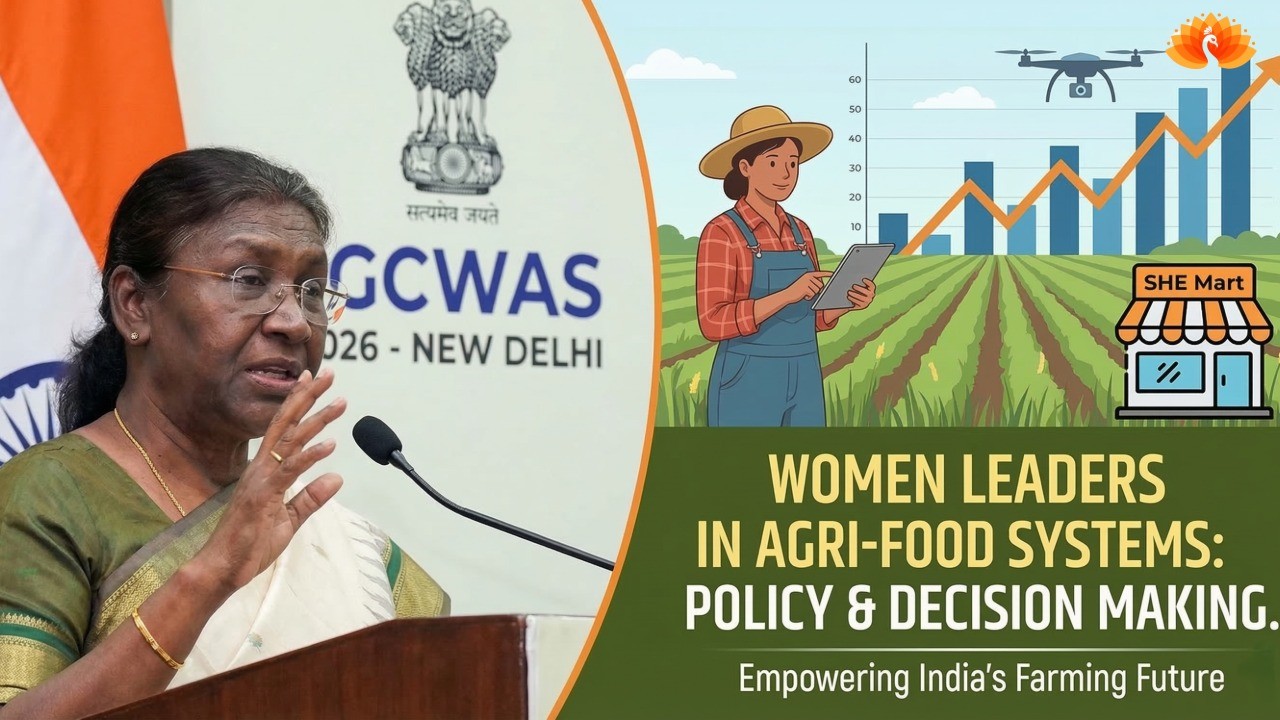
President Droupadi Murmu officially opened the Global Conference on Women in Agri-Food Systems (GCWAS) in New Delhi on March 12, 2026, making a strong call for structural change in India's agricultural sector. Going beyond the traditional view of women as only field workers, the President emphasised the pressing need to include women in policy development and decision-making, and even in leadership. The speech shed light on a strategic national shift of national development to women-led development, and this was much in line with the declaration by the United Nations of 2026 as the International Year of Women Farmers. The Critical Bottleneck: The Land Title and the Institutional Finance. One of the major themes of the Presidential speech was systemic oppression that hams down the economic independence of women in the agricultural value chain. Despite women being the backbone of the rural farming labour, almost all of them do not own land titles in their names. President Murmu openly requested specific interventions by the government in terms of correcting this land-title deficit. Without legal ownership of land, female agriculturalists are technically marginalised in receiving institutional finance, necessary crop insurance, and state subsidies. The proposed policy orientation by laying emphasis on property rights will turn women who are not recognised into formal agricultural entrepreneurs who are eligible for the banks to be able to scale their operations and have long-term financial security. Integration and Economic Empowerment. In order to close the gender disparity that has been present, the prevailing policy framework puts a heavy dependence on digital public infrastructure and modern technology in agriculture. President Murmu emphasised such innovations as the Sarlaben, an artificial-intelligence (AI) based tool that helps in the care of livestock, and the Namo Drone Didi scheme, which provides self-help groups (SHGs) of women with drones to help them do precision farming. These technologies are supported by widespread and active financial inclusion efforts. The President reported that today 56 cent of the 570 million Jan Dhan bank accounts are occupied by women and 68 % of all Mudra loan beneficiaries are women. Also, the government has aimed at providing six crore Lakhpati Didis (women earning above one lakh rupee per year) under the Deendayal Antyodaya Yojana -National Rural Livelihoods Mission (DAY-NRLM). Here, official figures released during the conference show that over three crore women have already reached this financial goal. Access to the Market and Grassroots Reality. Although a steady flow of policy and technological tools at a higher level offers a progressive roadmap, there is a holistic view of the industry that highlights the urgency to have strong, direct market connections. In the 2025-26 Union Budget, the introduction of the so-called SHE Marts, meaning community-owned retail stores located in each district to sell SHG products, is a significant move towards avoiding the usual, male-dominated intermediary channels. However, the institutional leaders and agricultural professionals who were present at the 3-day summit observed that these lofty goals can only be achieved by having uninterrupted performance on the panchayat level without any friction. Sensitising the divide between high-end digital devices and low-end rural digital literacy is currently a major on-the-ground issue. After all, the conference at GCWAS emphasised that, not only is the reduction of the gender gap in agriculture a social fairness issue, but it is also a precondition of ensuring global food security and sustainable economic prosperity in the long term.