NCERT withdraws Class 8 textbook after Supreme Court objection to judiciary chapter
Staff Writer: Zoya Ahmed
Published on: March 17, 2026, 12:55 p.m.
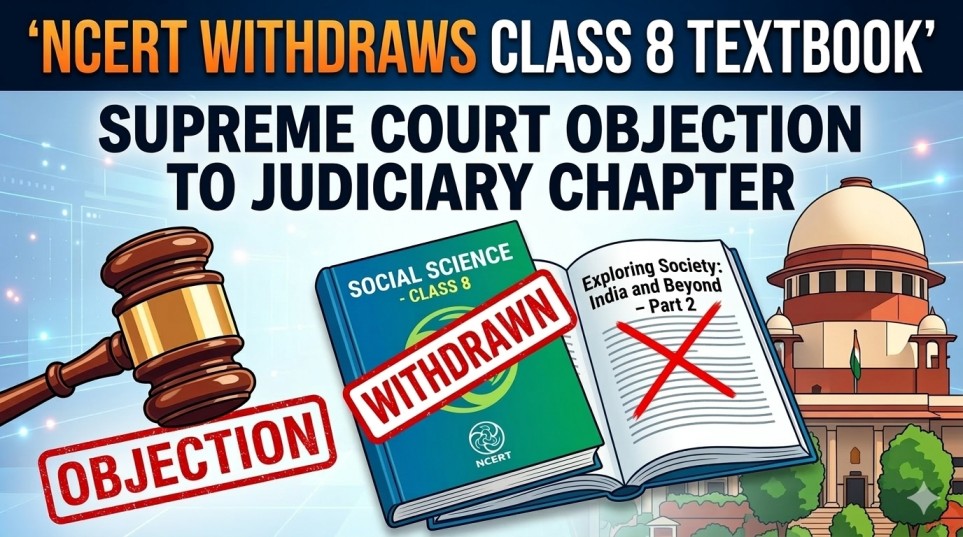
In a major move, which touches on the interplay of education and the constitutional powers, the National Council of Educational Research and Training (NCERT) has offered an apology to the Supreme Court of India, which is unqualified and unequivocal. The apology, which was made earlier this week, followed the scathing criticism by the apex court of a chapter in a recently published Class 8 textbook on Social Science, titled Exploring Society: India and Beyond – Part 2, which had discussed corruption within the judiciary. In chapter IV of the book, The Role of Judiciary in our Society, the judicial corruption, large amounts of cases in the backlog, and the lack of judges were specifically mentioned as the main difficulties of the Indian legal system. Also contained in it were the statistics of the millions of pending cases in the district courts, high courts, and the Supreme Court. The publication of such material provoked an immediate legal and political backlash. According to reports, the issue was raised before the Supreme Court of India by senior advocates, following which the court took suo motu cognisance of the matter. In reply, the Supreme Court of India came down strongly on the publication, saying the chapter appeared to be “a calculated move to undermine the authority and dignity of the judiciary.” The bench observed that, as much as criticizing the institution of the country is necessary in a democratic system, the decision to expose 13-year-olds to a highly partisan account, without sufficiently emphasizing the importance of the judicial system in safeguarding constitutional morality and basic human rights, may lead to the creation of false beliefs in the minds of juvenile citizens. Therefore, the court halted further publication and circulation of the current edition of the textbook. The bench directed that all the physical copies that were in circulation should be immediately recalled in schools and retail outlets. After the harsh judicial censure, NCERT hastily withdrew the content. In its release, the educational body said the textbook had been withdrawn and would be reviewed in light of the court’s observations. “The Director and Members of NCERT hereby give an unconditional and unqualified apology with respect to the said Chapter IV,” the council said. In further hearings, Solicitor General Tushar Mehta told the court that the Union government had requested NCERT to conduct a process of reviewing the textbooks in all standards and make systematic changes. The Supreme Court has since ordered that the textbook development team involved in the matter of the chapter be separated from any future curriculum-related activity financed by the exchequer. Going forward, the Supreme Court has instructed that any new revision of a chapter concerning the judiciary will be vetted by a newly formed committee of experts, which has at least a former senior judge, and then it can be placed in the classroom.