Investigative Reporting on India’s Air Quality Crisis
Staff Writer: Zoya Ahmed
Published on: April 14, 2026, 5:16 p.m.
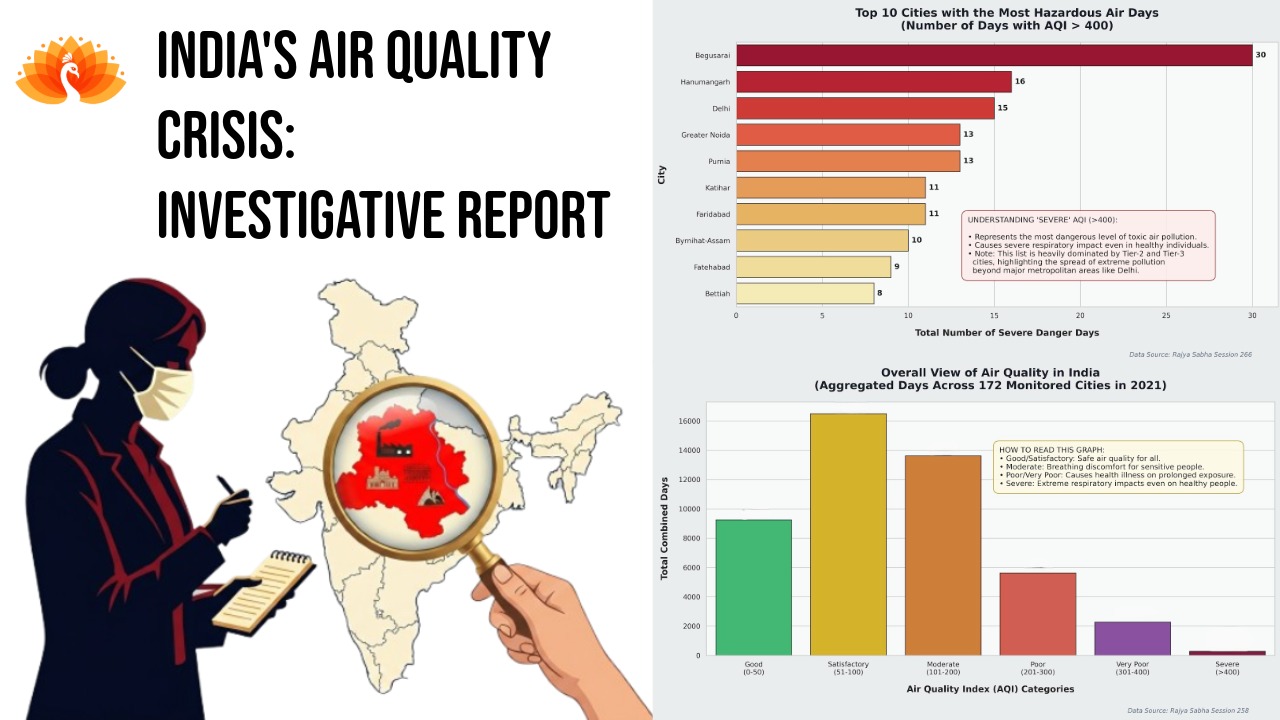
Air quality in India is officially measured using the Air Quality Index (AQI). The AQI acts as a simple scale to communicate how dirty or clean the air is on a daily basis. The government categorises the air into six simple levels: Good (0-50), Satisfactory (51-100), Moderate (101-200), Poor (201-300), Very Poor (301-400), and Severe (above 400). Any AQI reading that crosses the 200 mark is officially recognised as a dangerous "bad air day." When the air quality drops to poor or severe levels, it means the air is thick with microscopic toxic particles. Breathing this air forces harmful chemicals deep into the lungs and bloodstream. For the Indian audience, this translates into a devastating physical impact, leading to chronic asthma, heart diseases, and weakened immune systems in children. Furthermore, the constant confinement indoors and the anxiety of breathing toxic air take a significant toll on the mental health and emotional well-being of affected families. Figure 1 illustrates the overall view of air quality across various monitored cities in India, combining all the days recorded into a single national picture. The data presents a very concerning reality for public health. While a large portion of the daily readings remains in the safe "Good" and "Satisfactory" zones, the right side of the graph reveals the true scale of the crisis. When adding up the total days classified under "Poor," "Very Poor," and "Severe," the numbers climb into the tens of thousands across the country. This massive accumulation of bad air days proves that the pollution crisis is not just a temporary winter issue, but a year-round emergency. Millions of citizens are spending months at a time breathing air that is fundamentally unsafe, placing an overwhelming emotional and financial burden on households that must deal with mounting medical bills. Figure 2 from the recent dataset further analyses the absolute worst-case scenarios: the cities with the highest number of "Severe" days where the AQI crosses the hazardous 400 limit. Figure 2 shows a shocking shift in the geography of extreme pollution. For years, the media and government have focused almost entirely on major metropolitan areas like Delhi. However, the data reveals that Begusarai, a smaller city in Bihar, has become the most polluted city on this list, recording a staggering 30 severe air quality days. Hanumangarh in Rajasthan follows as the second highest with 16 severe days. Delhi now ranks third with 15 severe days. The rest of the top ten list is entirely dominated by smaller tier-2 and tier-3 towns. This includes Greater Noida in Uttar Pradesh (13 days), Purnia in Bihar (13 days), Katihar in Bihar (11 days), Faridabad in Haryana (11 days), Byrnihat in Assam (10 days), Fatehabad in Haryana (9 days), and Bettiah in Bihar (8 days). This clear pattern suggests that the highest levels of toxic air have moved away from the capital and settled into India's smaller towns. These areas are suffering heavily from rapid industrial growth, unregulated construction dust, and agricultural burning, but they completely lack the strict monitoring and protective measures found in larger cities. In conclusion, this investigation shows a painful contradiction in how India handles its environment. While on paper, the government has active plans and court orders to clean the air in big cities, the actual, life-threatening crisis is quietly choking the smaller towns. Cities like Begusarai and Byrnihat are seeing their citizens physically and emotionally drained by hazardous air, yet they receive a fraction of the attention. The real challenge moving forward is not just fixing Delhi’s smog, but ensuring that consistent implementation of pollution rules, strict monitoring, and healthcare support reach every single town. Clean air cannot remain a privilege for a few; justice for public health will remain selective rather than universal without widespread, systematic reform.